When Employers Change Their Story: A Guide for Disabled Veteran Employees
By Bradley J. Burt (adapted for public/legal context)
If you’re a veteran with a disability facing workplace discrimination or retaliation, you’re not alone — and understanding how employers sometimes defend their actions can be a powerful tool in your legal toolbox.
One of the most common tactics employers use to justify unlawful conduct is something called a post hoc justification. Let’s break that down in clear, everyday language and explore how it affects disabled, veteran, or otherwise protected employees.
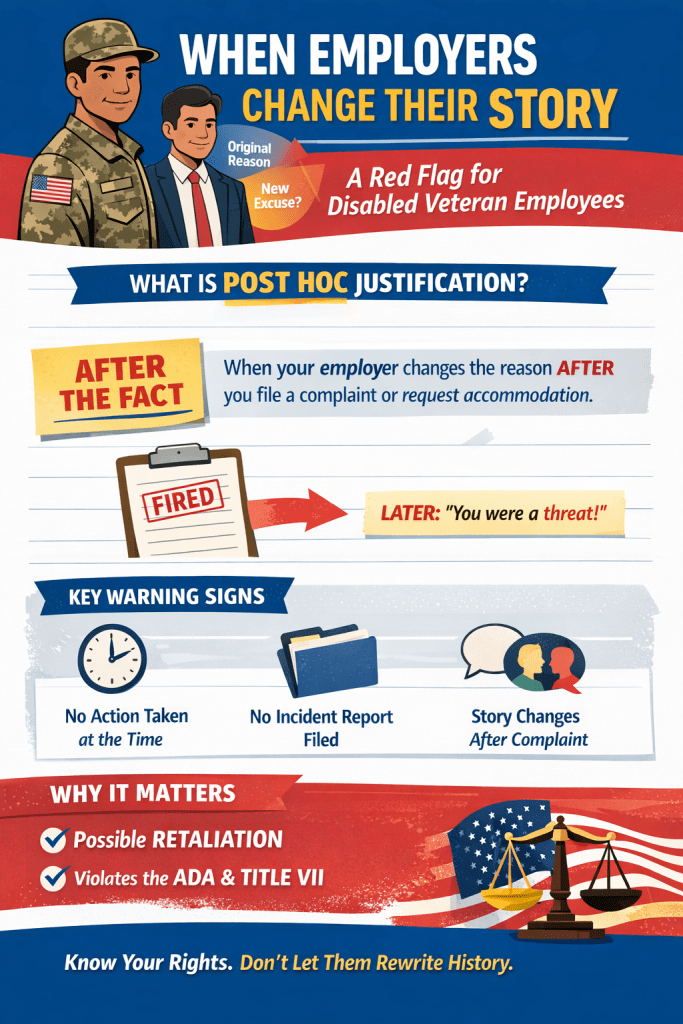
🎯 What Is Post Hoc Justification?
Post hoc justification literally means “after this, therefore because of this.” In legal terms, it’s when an employer offers a reason for firing you after the fact, rather than at the time of the event.
So instead of saying “We fired you for X” when you were actually fired, they say it later — often after you legally challenge them or allege discrimination.
This matters because:
It shows the employer’s stated reason wasn’t truly what motivated the decision.
It suggests the real reason might be retaliation for something protected — like disability accommodation requests or whistleblower complaints.
This is especially important for disabled veterans, who are protected under both federal law (ADA) and local anti‑discrimination ordinances.
📌 Example: The Threat That Never Was
Imagine this scenario:
You notify your employer you won’t work around a certain person because of a credible threat to harm you.
You ask to be excused for your safety.
No one investigates, makes a report, or documents anything that night.
You continue to work, but later you’re fired.
Then, months later, your employer claims you were fired because you “threatened violence.”
If there’s no contemporaneous report, no incident documentation, no witness statements at the time, and no HR action on the day of the event — that’s a strong indicator the “threat” reason was created after you complained or asked for accommodation.
That’s post hoc justification — shifting the reason after the fact to justify an adverse decision that was likely caused by something else (like your disability disclosure or protected complaint).
🧠 Why This Matters for Disabled Veterans
If your employer:
Returns with a new reason only after you engage in protected activity (like reporting discrimination),
Changes its explanation over time,
Or provides a reason contradicted by its own conduct or records,
then that’s not just a clerical mistake — it’s evidence that the stated reason is a pretext.
Pretext means the reason given is not the real reason.
And under both federal law (ADA, Title VII, ADEA) and many local laws (including Madison Ordinance § 39.03), pretext is exactly the type of evidence used to prove discrimination and retaliation
🔍 How to Spot Post Hoc Justification
Here are the key indicators:
✔ The employer didn’t mention the reason until after you complained ✔ There’s no contemporaneous documentation of the alleged conduct ✔ The employer’s policy for handling the alleged issue wasn’t followed ✔ Witness accounts don’t support the new justification ✔ You were previously evaluated as adequate or competent before the protected activity ✔ The timing of the termination closely follows your protected complaint
When these signs line up, it raises a strong inference of retaliation — not legitimate conduct.
🛡️ Why It’s Important for Your Legal Case
In discrimination law, you don’t always have to prove that the employer intended discrimination.
Instead, you show:
You engaged in protected activity (like reporting discrimination or asking for accommodation),
You suffered an adverse action (like termination), and
The employer’s stated reason is weak, inconsistent, or post hoc.
If the stated reason is pretextual, the law allows investigators, hearing officers, or judges to infer discrimination or retaliation.
This is true under:
Americans with Disabilities Act (ADA)
Title VII of the Civil Rights Act
Age Discrimination in Employment Act (ADEA)
Local anti‑discrimination ordinances like Madison Ordinance § 39.03
📣 A Word for Disabled Veteran Employees
You deserve workplace safety, accommodation, and equal treatment — period.
When an employer tries to justify a disciplinary action with a reason that only came after you exercised your rights, that’s exactly the kind of evidence that supports a retaliation claim.
So if you notice:
👉 reasons that change over time 👉 lack of documentation 👉 timing that follows your complaint
trust your instincts — it’s not just coincidence. It’s legal evidence.
Upon speaking with the VA Office of General Counsel, the struggle with medical record protection faces the crucible of a non-veteran legal counsel Agency representing the Respondent in the Wisconsin Equal Rights Discrimination Court. First, the Respondent’s lead counsel uses legal licensure to subvert the long-standing protections of disabled veteran patients. Second, the legal Agency for the Respondent will not entertain nor agree that limited interoggatories is proper despite several ongoing email discussions regarding proper VA medical record repoting. Last, I have unitl Feb. 6, 2026, to retrieve said documents when we all know how the VA operates on the setting of snail when requesting records.
Today, I looked over three of the questions found in the Respondent’s Counsel’s interrogatories relentlessly demanding I provide:
Intellectual property information used for the science communication research modeled under the LightFighter Syndrome® smart document work product fabrication for Microsoft currently under a Non-disclosure Agreement (NDA).
All medical evidence Documents and prescriptions support your claimed disability and/or medical condition.
All medical records, doctor’s notes, treatment notes, prescriptions, or evaluations relating to your claimed disability and/or medical condition.
For this reason, I must turn over my concerns to the William S. Middleton Veterans Memorial Hospital the request to file a Privacy Complaint. As patients, the VA puts us in the crosshairs of corporate citzen Goliaths like this one.
I am representing pro se and cannot find Contingency counsel. In many ways, this scenario seems biblical and all I have is prayer and meditation provided by the VA mindfulness programs. The road ahead shall outline in the Complaint how the State of Wisconsin does not sanction attorneys and restrict discovery to VA protocol. Instead, VA patients must face the wrath of Corporate Nebuchadnezzar who “wants ALL of the records” as previously stated.
My dissertation entry reports outline how the Wisconsin Equal Rights Division Administrative Law judge will make decisions outside the Court’s jurisdiction who is not the proper venue. Once discovery ends, the judge can sanction me to provide my VA records if the judge so chooses.
What is the venue?
Where is the attorney’s jurisdiction?
Why is the Wisconsin Administrative Law Court making Federal medical record decisions and why has the VA not acted in the best interests of patients to create a universal onboarding VA medical record smart document?
The State of Wisconsin Court System subjects VA patients to burdensome interrogatories. On Friday, I am meeting with an investigator after disrupting discovery and am uncertain how the Court can uphold the lawyer’s requests. I filed a grievance with the Wisconsin Supreme Court Office of Lawyer Regulation per the instructions provided to me by the VA Office of General Counsel. The subject matter in this case comprises using an AI Assistant for redacting non-accommodation disclosures and presentation to the public regarding secondary VA conditions irrelevant to the accommodation requested.
The end goal seeks stopping these corporate controlled employers from seeing your VA information automatically and creating precedent for future VA patients who seek working for employers who use AI for Human Resources VA medical record retrieval.
LEGAL NOTE: This document was developed from the Madison College Honors Research Project currently working with the VA Office of General Counsel seeking an attorney to guide the process of building a universal smart document for the protection of disabled veteran employees.
The subject matter argument presented in this blog communication shares a real life hypothetical regarding how Corporate Machiavelli will pressure you as a disabled veteran to turn over information when a “corporate citizen” suspects you as an employee have a service-related PTSD.
Human Resources papers you through documentation, who will later use the information in Court to identify you as “combative” or “threatening” when you challenge the legality of the retrieval of VA medical record information, which happened to me.
As a client with the Wisconsin Division of Vocational Rehabilitation who entered the workforce for Marcus Corp. working at the Sun Prairie Marcus Palace Cinema and Live Nation d/b/a Frank Productions LLC at the Sylvee, the Majestic, Breese Stevens Field, High Noon Saloon and the Orpheum, both employers DID NOT follow proper VA Privacy Guide Protocol.
For my upcoming meeting with Marcus Corp.’s counsel, the Respondent’s counsel requires I turn over my secret security clearance and ALL information regarding my socials protected under discrimination argumentation by the Federal Labor Relations Act. The corporate citizen uses intimidation of an irrelevant subject matter to intimidate me into submission, which I will not do.
I am required to disclose information without my consent along with answer burdensome questions in the form of interrogatories that do not apply in this case. The Respondent’s counsel also requires I provide confidential communication by Tribolt Security LLC’s Chief Executive Officer Dave Marerro, a well-known and respected Special Forces operator. I have informed the Wisconsin Supreme Court Office of Lawyer Regulations regarding my perception of intimidation that resulted from the adherence to filling out both Respondents’ interactive dialogue process questionnaire seeking information beyond the scope of requested accommodations, which employers cannot do.
As an upstander and 10th Mountain Division QRF observer reporter in the community, I exposed the information publicly and now I must face the wrath on March 12, 2026, at my Wisconsin ERD appeal hearing facing off self-represented as a law student against Marcus.
The substantive fact in both cases comprises prima facie that the employers received multiple complaints and management did not escalate to Human Resources regarding multiple employees who threatened violence that eventually led to the termination of one who stated, “Don’t just die! Suffer!” The managers stated the dialog reported by multiple employees “did not rise to the occasion” to escalate. Yet, according to the information provided to me by Lt. Cindy Holmes of the Dane County Sheriff’s Dept., who declared most certainly did.
Note: After calling out trolling by the Majestic Venue Manager, who later quit, the company engaged in papering. The questions went outside the scope of requested accommodations. You as a disabled veteran, upon bringing forward concerns for adverse actions, will receive papering in the from of an interactive dialogue process questionnaire.
Frank Productions LLC terminated me after I declined to blindly follow the employer’s demands I fill out an interactive dialogue process questionnaire. The overreaching scope of both parties’ questionnaires exceeded the protocol of VA patient “self-reporting.” Frank Productions LLC, not being happy with the response by the VA’s primary care provider, made clear I needed to go to “real” primary care provider to clear me as a perceived threat. No civilian primary care provider can access your VA records without your permission and this royally pissed the Human Resources manager off as I reported here in previous DVR discrimination blog press release reports as outlined in my college indpendent study.
Frank Productions LLC, the author of the document currently submitted to an ERD investigator as an exhibit, models a similar attempt to legally retrieve information from the VA suspecting I was a disabled veteran with PTSD for making clear I must first speak with my VA primary care doctor, the VA Privacy Director, EEOC Senior Legal Analyst Sharron Rennert and the DVR director before sharing information that could expose what I did while serving as a Special Forces commander’s RTO in Haiti while serving on QRF.
The companies dug deep and because I resisted, I was a perceived threat for standing up for VA patient medical record privacy that I perceived as discrimination. For the sake of protecting fellow deployment vets, I shared my DVR progress report observations publicly to warn other veterans, which is my legally protected right to do here at Outpost 422.
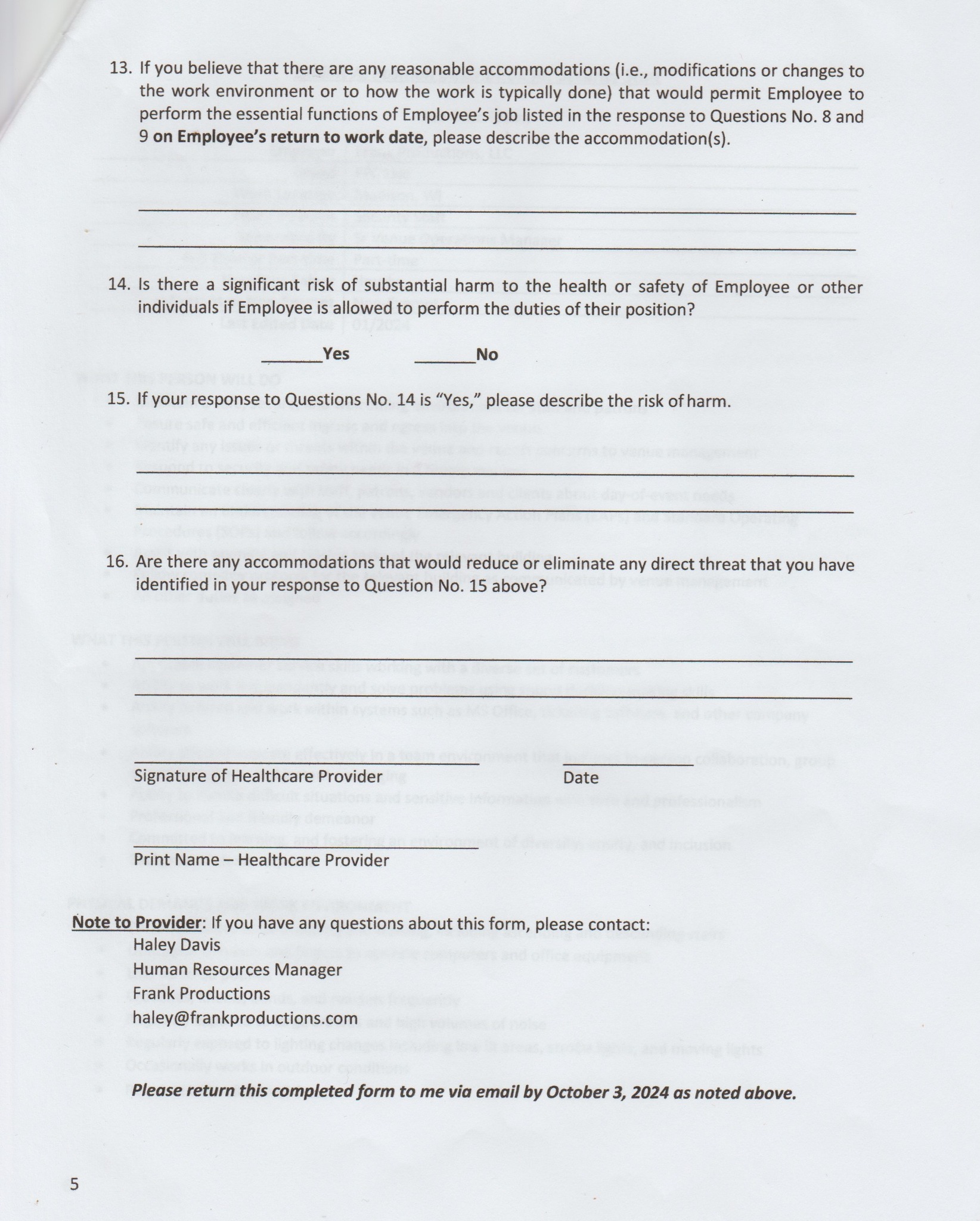
I later self-reported through my VA primary care provider I have “LightFighter Syndrome (migraines),” which was an amendment I field with my VA record privacy to discuss publicly my time down range regarding my traumatic brain injury. I was informed I did not need to disclose any condition other than what I was requesting accommodations for yet the employers made ironclad either I fill out the forms or risk losing merit and had Frank Productions LLC CEO Joel Plant make clear would not accommodate me unless the form featured below was filled out. For this reason, I have rebranded Outpost 422 as a VA Patient Adjudicator service to inform those who are afflicted by a bad-faith employer who uses interrogatories and Human Resources demands to intimidate you into availing a PTSD diagnosis for papering purposes.
The service is registered with the VA Inspector General Office to connect you as a VA patient with information regarding how to connect with free VA pro bono legal services to help you navigate.
Concerted Activity: The Federal Labor Relations Act
You have the right to act with co-workers to address work-related issues in many ways. Examples include: talking with one or more co-workers about your wages and benefits or other working conditions, circulating a petition asking for better hours, participating in a concerted refusal to work in unsafe conditions, openly talking about your pay and benefits, and joining with co-workers to talk directly to your employer, to a government agency, or to the media about problems in your workplace. Your employer cannot discharge, discipline, or threaten you for, or coercively question you about, this “protected concerted” activity. A single employee may also engage in protected concerted activity if he or she is acting on the authority of other employees, bringing group complaints to the employer’s attention, trying to induce group action, or seeking to prepare for group action. However, you can lose protection by saying or doing something egregiously offensive or knowingly and maliciously false, or by publicly disparaging your employer’s products or services without relating your complaints to any labor controversy.
Denying an employee/former employee’s right to uphold Wis. Stats. 103.20, specifically “Hours of Operation,” I reported my concerns to the director of DVR in the form of blogs and social media posts fully protected under my civil rights under said Act. After filing an ERD complaint, retaliation for speaking publicly began by Attn. Welsh in the form of interrogatory who willingly acted above the language contained in DWD 218, while I self-represented through the Outpost 422 whistleblowing agency.
The Federal Labor Relations Act Section 1.[§151.] states, “The denial by some employers of the right of employees to organize and the refusal by some employers to accept the procedure of collective bargaining lead to strikes and other forms of industrial strife or unrest, which have the intent or the necessary effect of burdening or obstructing commerce by (a) impairing the efficiency, safety, or operation of the instrumentalities of commerce; (b) occurring in the current of commerce; (c) materially affecting, restraining, or controlling the flow of raw materials or manufactured or processed goods from or into the channels of commerce, or the prices of such materials or goods in commerce; or (d) causing diminution of employment and wages in such volume as substantially to impair or disrupt the market for goods flowing from or into the channels of commerce.”
Of course, for our veteran community protection, I filed an EEOC Whistleblower complaint against Attn. Welsh along with a grievance with the Wisconsin Supreme Court Office of Lawyer Regulation for trying to retrieve my federally protected military service information but also protected information pursuant the VA Privacy Guide. So, I woke up on Christmas Day and got to work preparing for our upcoming New Year’s Eve “concerted activity” protected conversation. Here is what ChatGPT has to say about what your employer must provide you upon your signature of an accepted employment offer:
Below is ADA-, EEOC-, and veteran-compliant onboarding language that employers commonly include in offer packets, employee handbooks, or onboarding portals. This language is neutral, avoids unlawful inquiries, and properly opens the door to accommodations without singling out VA patients, veterans, or PTSD.
You may use this verbatim or adapt it with counsel.
[Company Name] is an equal opportunity employer. We do not discriminate against applicants or employees on the basis of race, color, religion, sex, sexual orientation, gender identity or expression, national origin, age, disability, genetic information, military or veteran status, or any other status protected by applicable federal, state, or local law.
Employment decisions are based on qualifications, merit, and business needs.
2. ADA Reasonable Accommodation Notice (Critical Section)
Reasonable Accommodation
[Company Name] is committed to providing reasonable accommodations to qualified individuals with disabilities in accordance with applicable law.
If you need a reasonable accommodation to perform the essential functions of your job, or to participate in any part of the onboarding or employment process, please contact Human Resources at [HR contact information]. Requests will be handled through an interactive process and kept confidential to the extent required by law.
Why this works legally
Invites disclosure without coercion
Does not reference PTSD, mental health, or VA status
Triggers ADA duties only if the employee initiates
3. Medical Information & Confidentiality Statement
Medical Information Confidentiality
Any medical information provided to [Company Name] will be maintained in a confidential file separate from personnel records and will be disclosed only as permitted by law.
Employees are expected to perform the essential functions of their positions and to comply with all company policies and performance standards. Reasonable accommodations may be provided where required by law; however, accommodations do not eliminate essential job functions or performance expectations.
This protects the employer from later claims that standards were waived.
5. Safety & Conduct Statement (ADA-Compliant)
Workplace Conduct and Safety
[Company Name] is committed to maintaining a safe and respectful workplace. All employees are expected to follow safety rules and standards of conduct. Employment actions are based on observed conduct and performance, not on assumptions about medical conditions or personal characteristics.
This language is important if safety issues later arise.
6. Veteran & Military Status Protection (Optional but Recommended)
Military and Veteran Status
[Company Name] values the service of members of the U.S. Armed Forces and complies with the Uniformed Services Employment and Reemployment Rights Act (USERRA). Employees will not be discriminated against based on past, present, or future military service.
7. Optional Onboarding Portal Checkbox Language
☐ I understand that if I need a reasonable accommodation to perform my job or to participate in the onboarding process, I may contact Human Resources.
This creates a record without forcing disclosure.
8. Language You Should NOT Include (for Compliance)
Do not include:
Questions about PTSD, mental health, or VA treatment
“Voluntary disclosure” checkboxes about disabilities before employment begins
Language suggesting veterans or VA patients require special monitoring
Broad consent for medical records
Legal Bottom Line
This onboarding language:
Complies with the ADA and EEOC guidance
Avoids unlawful medical inquiries
Protects veterans under USERRA
Preserves employer performance and safety authority
Minimizes discrimination and retaliation risk
Stand up for your rights to expose employers who stigmatize military service PTSD. Report employers to the Better Business Bureau who profile fellow disabled veterans as threatening like Live Nation did to me on the night of Tammy Baldwin’s Election Nov. 5, 2024, which led to my termination and a ban letter for a baseless allegation of threatening violence. And most of all, the demands mutually expressed by both Marcus Corp. and Live Nation I comply with fully filling out their interactive dialogue process questionnaire, which the VA says cannot do.
Keep checking in at Outpost 422 in the upcoming months as I start to slowly leak publicly available information regarding my discrimination cases filed with the the City of Madison Equal Opportunity Commission, Wisconsin Equal Rights Divsion, and the Equal Employment Opportunity Commission who are the venues and judicial oversight of my ongoing appeals and my upcoming TDIU severance hearing in Milwaukee, Wis. regarding the unbecoming conduct that led to receiving my severance letter by the two aforementioned parties.
Outpost 422 is a VA Patient Adjudicator service. If you would like to discuss legal options available to you provided pro bono to VA patients, please fill out the contact form.
Whitewater, WI — Bradley J. Burt, founder of Outpost 422 and a University of Wisconsin–Whitewater 2023 summa cum laude undergraduate alumnus, has advanced to Round Two of Microsoft’s Hackathon 2025. Burt, a student veteran awarded the 10th Mountain Division Armed Forces Expeditionary Award, was selected as one of only 94 entrants nationwide accepted into the prestigious competition.
Burt’s acceptance into Hackathon 2025 builds upon a research-driven creative project launched as part of a convergent media independent study conducted from 2022–2023 under the guidance of Dr. Kathy Brady and Dr. James Kates in UW–Whitewater’s Communication Department. During this period, Burt developed and registered the trademark Outpost 422, a research and writing framework designed to explore the lived experiences of student veterans facing learning barriers associated with combat stress, traumatic brain injury (TBI), and post-traumatic stress disorder (PTSD).
Burt presented Microsoft with a detailed account of how Outpost 422 functions as a form of gonzo research—a self-reflective, data-driven diary—built around Brady’s Feature Writing 303 story-weaving techniques. This approach merges Brady’s Interpersonal Communication 228 self-monitoring framework with Kates’ valedictory essay structure, resulting in a hybrid methodology Burt calls “Gonzo-19.” The model examines fear, stress, and academic dissonance from the perspective of a student veteran navigating higher education systems.
“My research examines what I describe as cultural incongruity—the often-unspoken friction between traditional students and student veterans working together on college campuses,” Burt said. “By documenting these experiences through self-reporting and reflective analysis, Outpost 422 attempts to create a bridge of understanding for educators, clinicians, and institutions.”
Burt’s work blends Veterans Health Administration patient self-reporting models with science communication, transforming introspective examination into structured qualitative data. This method formed a core variable in his undergraduate honors research and continues to guide his current academic pursuits. As a post-baccalaureate legal studies student at Milwaukee Area Technical College, while concurrently attending Madison Area Technical College, Burt applies the same reflective methodology alongside legal research and policy analysis.
Microsoft recognized Burt as a “hacker” entrant for his innovative, interdisciplinary approach. Advancement to Round Two—known as the “Make-a-thon”—places Burt among a select group of veteran participants nationwide tasked with developing practical, data-informed solutions.
Dr. Brady and Dr. Kates were instrumental in creating an academic environment that allowed Burt to explore gonzo journalism as a legitimate scholarly tool. Their support enabled him to transform personal writing challenges into a scalable research mechanism intended to assist future student veterans who struggle with academic writing.
“The Communication Department became an outlet for understanding symptoms I didn’t yet have language for,” Burt explained. “The Freedom of Academic Expression allowed me to explore unconventional writing methods—particularly gonzo journalism, popularized by Hunter S. Thompson—as a way to process service-related experiences and learning barriers tied to a traumatic brain injury I only discovered long after enrolling in college at age 42.”
During the Make-a-thon phase, Burt will collaborate on Microsoft’s “Care Connect” team, where he will create several datasets aimed at helping the company better understand Veterans Affairs patients and psychological stress disorders. His contribution will focus on transforming firsthand student veteran experiences into Microsoft Excel–based introspective analysis tools designed to provide structured outlets for emotional processing and frustration management.
Currently a law student, Burt uses gonzo research and science communication reporting as a counterbalance to the rigidity of legal writing. Following the conclusion of Hackathon 2025, he plans to file a patent related to his methodology. Burt will also conduct workshops with groups of student veterans, offering writing samples and self-monitoring techniques inspired by Brady’s “shift-on-the-fly” final project model. These efforts aim to support Microsoft’s exploration of artificial intelligence–driven patient self-reporting systems built upon micro-level introspective data.
Looking ahead, Burt hopes to return to UW–Whitewater in 2028 through its online programs to pursue a master’s degree in data analytics, alongside a graduate certificate in entrepreneurship at the University of Wisconsin–Milwaukee. His long-term goal is to continue studying the psychological and sociological barriers student veterans face during college readjustment and reintegration.
That journey began with his undergraduate honors research, supported by Andersen Library librarian Dr. Naomi Schemm, who guided Burt through the creation of a comprehensive literature review.
“Dr. Schemm taught me how to build a reference list with confidence,” Burt said. “Her enthusiasm and professionalism embodied what student support should look like in higher education.”
Schemm helped Burt build the references list and develop an understanding with examining a scientifc variable as featured below:
Burt built Outpost 422 as a form of “stay-at-home” diary during the pandemic as a final project assignment with Brady’s Interpersonal Communication 228 course. Burt learned the greatest barrier to success was an undiagnosed traumatic brain injury and used the journaling method combined with scientific variable examination for treating learning disabilty symptoms.
Now, Burt will work with Microsoft to create a patient self-reporting method called “LightFighter Syndrome” that better serve VA patients through mindfulness and resilience symptom management. As a dataset, Burt’s Madison College/UW-W honors research will focus strictly upon the Madison College Veterans Integration to Academic Leadership (VITAL) program that currently needs auditing for VA patient college classroom instructor abuse Burt reported to the Dept. of Education. Upon evaluation, the VA patient adjudicator service of Outpost 422 will act as the auditing agency once the Microsoft VA project adjourns.
During 2026, Burt hopes to launch a pilot at the VA in the form of a creative writing newsroom called “The Jaded Patriot Press” that will capture the warrior managing a battle-ready mindset when dealing with a narcissist in the workplace or in the college classroom. Then, as Jaded Patriots, those who wish can use the self-regulation diary management symptoms for reporting disparate treatment to Outpost 422. The material will then be a part of a five-subcategory subset for analyzing secondary VA conditions resulting from hostile work and learning environments to collect data regarding disparate treatment in the form of cultural incongruity escalated by narcissists who abuse veterans in the workplace and college classroom.
Please continue to check the ongoing progress of this website as the process of developing a trading post of legal and VA patient advocacy research kicks off in 2026. Please click the “###JPP link below and see the sample of science communication variable examination develops the understanding of the battle-ready minded learner into resilience through a pseudonymal gonzo research approach. The Jaded Patriot Press examines fear, the crucible of loathing, honor, and glory modeled by those who exercise G.I. Education benefits.
Are you a veteran stuck in bewilderment regarding reporting harassment, intimidation or the like as discrimination? Please check out the ChatGPT Legal Assistant research available to you at no cost. Also, if you are a veteran in Dane County, Wisconsin, contact your local VA social worker who can help you navigate locating pro bono services.
ChatGPT Legal Assistant Thesis Question: What is the threshold that Wisconsin Fair Employment investigators use for determining disparate or pervasive treatment? Is there a document?
1. Disparate Treatment Under Wisconsin Law
Definition (Intentional Discrimination)
Wisconsin’s Fair Employment Law makes it unlawful to treat employees or applicants less favorably in employment because of protected characteristics such as age, race, sex, disability, etc. if the adverse action is at least in part due to that protected status. Wisconsin Workforce Development
This is similar to the federal disparate treatment concept: an intentional adverse decision based on a protected class. Wikipedia
Investigator Threshold
There is no publicly-posted numeric or percentage “threshold” (e.g., “X number of instances”) that Wisconsin investigators use to decide disparate treatment. Rather, the Equal Rights Division looks at whether discriminatory intent or motivation can be inferred from the evidence — for example, whether a protected characteristic was a motivating factor in the adverse action.
In practice this is often assessed through evidence such as comparative treatment of similarly situated employees and whether the protected trait influenced the decision.
Document Source
The Wisconsin statute itself (Chapter 111, Sections 111.31–111.395) defines unlawful discrimination, but doesn’t set a numerical threshold. A widely disseminated Wisconsin Fair Employment Law poster summarizes what is unlawful but does not quantify thresholds. Wisconsin Workforce Development
🧠 2. Harassment / “Severe or Pervasive” Conduct in Wisconsin
State Law Standard
For harassment (hostile work environment) under Wisconsin law, the conduct must be:
Because of a protected characteristic, and
More than a few isolated incidents or casual comments, involving a pattern of abusive, degrading conduct that interferes with work or creates an offensive/hostile environment. Wisconsin Workforce Development
This standard echoes “severe or pervasive” definitions used in federal law (e.g., Title VII) but under Wisconsin law is framed around pattern and workplace interference — again without a numeric cutoff.
📄 3. Official Guidance or Investigator Manuals
State Guidance
Equal Rights Division User Guides exist for procedural and case-management matters, but not policy thresholds for substantive legal standards. Wisconsin Workforce Development
Wisconsin DWD/ERD does not publish an investigator manual setting a precise numeric threshold for disparate treatment or harassment.
The ERD Civil Rights webpages outline what constitutes discrimination and harassment but do not specify an exact “tests” or cut-off counts. Wisconsin Workforce Development
Secondary/Internal Documents
Some informational documents (e.g., Fair Employment Law Basics or Equal Rights Decision Digest) summarize decisions and elements from past cases, which can be useful for research but are not policy manuals issued to investigators for threshold determinations. LIRC Wisconsin
📌 4. Analogous Federal EEOC Guidance (Useful for Context)
While not Wisconsin law, federal Equal Employment Opportunity Commission (EEOC) guidance on disparate and pervasive treatment — such as in hostile work environment claims — is often used as a reference in training or investigations:
However, again, no specific numeric threshold is prescribed — assessments are fact-intensive and context-driven. EEOC
“Severe or pervasive” harassment standards are explained in EEOC guidance (e.g., hostile environment harassment must be sufficiently severe or pervasive to alter terms/conditions of employment). EEOC
🧾 Summary
Issue
Wisconsin Standard
Threshold / Document
Disparate Treatment
Intentional unfavorable treatment because of a protected class
No official numeric threshold; assessed factually
Harassment / Pervasive
Pattern of abusive conduct tied to protected status interfering with work
No automatic numerical cut-off; fact pattern evaluated
Policy / Manual
ERD provides process info and law summaries
No public “investigator threshold” manual found
📌 Where to Find More Detailed Official Materials
Here are links you may review for statutory language and official explanations:
The blog is a legal reference that does not constitute “giving legal advice,” rather is an informative tool to help veterans understand their rights protected under Wis. Stats. 111.32. Please contact the Wisconsin State Bar if you are seeking information regarding how to obtain counsel. The VA will help you overcome worry and fear and face the obstacle of advocating for military service fair employment.
If you have a tip, lead or need please contact the Outpost 422 evidence intake agency at Bob Cobb on Facebook. Bob is the Capitol Wolfwatch customer service connect who will walk with you each step anonymously.
Hi, and welcome to Outpost 422. America’s 11th Hour Crisis Overwatch for those who identify as at-risk veterans, student veterans in academic distress, and those returning home from deployment on the verge of ending their term of service feeling hopeless without guidance or direction.
The service this website provides shares ongoing situations the author faces when adversity challenges the author to act who does so in the form of discrimination complaints. Discrimination complaints send the message that the employer or college institution must comply to agreed upon standards that require welcome treatment to those who served.
As a Veterans Health Administration patient, the author observes static communication. The blogs provide science communication journals modeling how to navigate disparate treatment through the protection of patient self-reporting publication.
Outpost 422 is a shorthand diary writing method providing examples of VHA patient self-reporting by:
Writing introspection diaries through gonzo research reports.
Illustrating substantive facts when under spiritual attack during groupthink situations on campus, in the college classroom, and in the workplace.
Acts as an adjudicator and advocate for military service identity civil rights.
The author’s reports provide retrospective observation analysis regarding military-minded individuals who face cultural incongruity.
The website provides information as a secondary opinion for legal research and citation, supporting reports addressing disparate and pervasive treatment in the workplace and the influence of certain ideological practices on American values in education and hiring.
American veterans require a welcome space pursuant the USERRA Act of 1994 that all college institutions and workplaces must abide by, which also includes Title VII of the Civil Rights Act of 1964. DEI has ended and student veterans reserve the right to challenge critical race theory manipulation by employers and instructors who chastise veterans for their military service.
Stand up. Sound off. Exercise your academic freedoms availed to you through your hard-earned G.I. Benefits.
Leave a comment or send a message. Now, more than ever, we must fundamentally change the hidden agenda undermining Americanism.
Contact
Outpost 422 is your backup battle brother. Sound off if you have something to say or would like to connect regarding concerns for veterans in your community afflicted by woke.
LightFighter Syndrome® – Cleaned Definition for VA IU Evidence
LightFighter Syndrome® (noun) A term describing the combined effects of multiple service-connected physical and mental health conditions experienced by veterans who served in rapid-deployment infantry units such as the U.S. Army 10th Mountain Division. The condition reflects the long-term functional impact of deployment-related trauma, chronic stress, and secondary medical issues that interfere with reliable occupational and academic performance.
Veterans experiencing LightFighter Syndrome® commonly report chronic symptoms including night terrors, intrusive memories, hypervigilance, disrupted sleep, impaired concentration, and intermittent disorganized or pressured speech under stress. These symptoms often contribute to workplace misunderstanding, disciplinary actions, or administrative labels indicating perceived risk—such as “threatening violence” identifiers applied by supervisors or Human Resources personnel when the veteran’s behavior is misinterpreted.
The condition is further aggravated in academic or employment settings where the veteran faces stigma surrounding mental health, combat service, or misunderstandings about behavioral symptoms. Many affected veterans experience cultural incongruity, defined as difficulty adjusting to civilian social norms, communication expectations, or institutional environments. This may result in social isolation, miscommunication, and being wrongly perceived as disruptive, aggressive, or unwilling to conform.
For student veterans, LightFighter Syndrome® can significantly impair academic engagement, particularly in classroom environments where the veteran feels singled out, marginalized, or ostracized due to their military background. These combined psychosocial and functional limitations often result in decreased reliability, difficulty maintaining employment, and challenges sustaining academic progress.
Purpose and Use of the Term
The term LightFighter Syndrome® serves as a self-reporting and documentation framework designed to help veterans describe the cumulative effects of deployment trauma, chronic stress conditions, and social barriers. The narrative style uses journaling, symptom tracking, and retrospective reporting to help communicate functional limitations to medical providers, employers, and academic institutions.
The term is currently registered through the United States Patent and Trademark Office (USPTO) under the principal investigator’s trademark, Outpost 422, and is used as a personal research-based writing device for documenting psychosocial stressors, evidence of functional impairment, and the lived experience of veterans encountering workplace or academic hostility, stigma, or intimidation.
Reference
McAndrew, L. M., et al. (2019). Cultural Incongruity Predicts Adjustment to College for Student Veterans. Journal of Counseling Psychology, 66(6), 678–689. https://doi.org/10.1037/cou0000363
I, Bradley J. Burt, named patient, request a hearing outlined in the instructions from the letter from the Oct. 31, 2025, letter I received from the Dept. of Veterans Affairs regarding severing my individual unemployability. The issue of gainful employment only reported exceeding the National Poverty Line threshold and not substantive facts in this case, which I have provided as an overview of retributive attempts by employers who challenged VA protocol with their interactive dialogue process questionnaire, I have been informing the VA of since 2021.
The problematic onboarding intimidation and harassment I receive stems from papering me for having suspected war-related PTSD. I was diagnosed with Traumatic Brain Injury and requested TBI accommodations. Now, as a result, my disability increased resulting from Human Resources demands I provide secondary conditions I will not provide due to protecting my role with National Security information shared with VA social workers regarding working with Special Forces as an M-60 RTO in Haiti. I absolutely refuse to breach my secret security clearance thus creating hazing by Human Resources.
The VA stated the VA cannot get involved in employment matters leaving me prey to attacks I have received up to and including meeting with Lake Effect Strategic HR & Law Human Resources Advisor Jennifer Lindberg who indicated my dialog regarding TBI attacks and requests for accommodations by her client, Live Nation d/b/a Frank Productions LLC, believed my discussion warranted concerns for coworker safety who profiled me, then terminated me for a perception of an active threat. I have provided in my URL link portfolio exhibits that will expand in detail at my hearing if the VA should choose to proceed who lacks the grounds to do so.
I am submitting this statement to document my concern regarding disparate treatment I have experienced as a disabled veteran employed by Frank Productions LLC.
As an individual who has served in the military, I have encountered a workplace environment that I believe does not provide a welcoming or inclusive space for veterans. I have observed behaviors and policies that appear to reflect bias against my background and beliefs as a veteran. These experiences have led me to feel marginalized and unwelcome.
I have reported this matter to the Department of Veterans Affairs Office of Inspector General (VA OIG), expressing concern that the systemic oppression of disabled veterans in certain workplaces remains unaddressed. I have described this pattern of behavior under the term “LightFighter Syndrome®”, referring to the ongoing discrimination and exclusion of disabled veterans within civilian employment settings.
It is my sincere hope that my complaint will be reviewed and addressed as a matter of concern, in accordance with the VA’s patient privacy and protection guidelines. Veterans deserve to work in environments that respect their service, dignity, and right to fair treatment without bias or retaliation.
I have acted above and beyond the call by notifying the public through my WordPress self-reporting VA Patient Adjudicator outlet, Outpost 422, which examines the variables of college and employment readjustment and reintegration of combat veterans being a combat veteran who successfully graduated Summa Cum Laude as a Madison College VITAL patient. Severing my unemployability only makes matters worse.
Now, I cannot obtain gainful employment and have substantive proof of such claims I shall bring before the VA. What I seek in exchange is a letter sent to previous employers by the Secretary of the VA. The problem in Madison, Wis., we patients face is Communism and a governor who violates our rights by flying the colors improperly.
We are under duress at Madison College who hosts the VA’s VITAL program and request an audit and possible removal of the program and transfer to UW Milwaukee where patients are served best. Madison College is a domestic terrorism safe harbor and have left my role as the Student Senate vice president of legislative affairs after receiving the report our vice president of public relations identified as such. I received an email attack by the Madison College Student Senate advisor and vice president of administration and finance while taking my law final. I identified the issue as hazing and usurping, then tenured my resignation.
I respectfully request that the VA consider whether a hearing is necessary at this stage, given that my employment records with Live Nation reflect ongoing complications related to my prior report and subsequent termination. The letter contains statements I believe are inaccurate, and I intend to provide documentation to clarify these points. Former employers’ automated reporting systems appear to have mischaracterized my actions, resulting in significant reputational and employment harm.
Currently, I have over a dozen discrimination complaints pending against multiple parties and until the subject matter from all of my cases adjourn with a ruling, I am no longer gainfully employable and noted with the Social Security Administration that my date of termination, Nov. 8, 2024, was the date I was no longer able to obtain gainful employment, which was the day Live Nation d/b/a Frank Productions LLC terminated me for alleged threatening violence and remain on FPC’s ban list wrongfully.
As a client serving down range at the Marcus Palace Cinema in Sun Prairie, Wis., Bradley Burt met a cook by the name of Jason Cain and the two discussed a program called “MarcusQRF” that requested the company offer an incentive for upstanders.
The company rejected the idea. Now, Mayor Steve Stocker and Bradley Burt have spoken and exchanged business cards during the Tues. Oct. 7, meeting sharing the planning of a public safety anonymous tip reporting outlet called #SunPrairieQRF.
The project is an archive and data-driven micro local news reporting station operating through the registered trademark reporting style of Outpost 422, the author’s intellectual property development with class projects and volunteerism as a student veteran who attends the University of Wisconsin-Milwaukee at Madison College. The author combines the University of Wisconsin-Madison Watchdog 101 workshop news reporting style with an Op-Expose format as the inventor of a convergent media interactive news connect between citizen and journalist.
Mayor Stocker gave the author his business card and as of Nov. 7, 2025, #SunPraireQRF is set to launch as a pandemic news reporting mockup by recording the material from home and broadcasting through FM radio as a podumentary invention working in the film industry.
Subject: Public Safety Awareness and PSA Collaboration
Good morning, Mayor Stocker,
I hope this message finds you well.
Since my October public comment at the City Council meeting, I’ve been working on launching the public safety campaign on X/Twitter, and I’d like to share the attached PSA with you. Earlier this week, I dropped off my show’s hard drive to Collin Lessig, who mentioned that scheduling details are still being finalized.
Talking About Stalking in Sun Prairie, Wisconsin
At this stage, I don’t yet have a confirmed date or time for the program’s launch. In the meantime, would you consider including the PSA in your newsletter or sharing it through any public safety-related channels?
When I receive public safety-related information, I plan to report it to you in a way that protects the identity of individuals who share tips—for example, by referencing that “Bob Cobb sent x, y, z.” I’ve cc’d Collin on this message and would appreciate being included on any public safety communications your office distributes. My goal is to help translate those updates into short podcasts and posts for X/Twitter to promote awareness.
Inspired by Sheep, Wolves, and Sheepdogs by Lt. Col. Dave Grossman, this project—The Expositor—aims to build community engagement through the Blue Star Program and the McGruff the Crime Dog initiative. The message emphasizes that Sun Prairie remains “Sun Prairie Strong,” reflecting our shared commitment to safety and resilience.
This issue is deeply personal to me, as I have firsthand experience with stalking and its effects on families. As a 10th Mountain Division veteran of Operation Uphold Democracy, a father, and a longtime community member, I hope to collaborate with your office and the Sun Prairie Media Center to foster a positive, ethical, and supportive dialogue around public safety.
Much of this initiative draws on my background from the Whitewater Citizen’s Police Academy and my time reporting for the Royal Purple at the University of Wisconsin–Whitewater. The #SunPrairieQRF project is part of an independent study focused on empowering citizen journalists and promoting “upstander” awareness within our community.
Thank you for your time and continued leadership. I look forward to the possibility of working together to strengthen our city’s safety initiatives.
After concerns arose during the Oct. 24, 2025, Madison College Student Senate Executive Council meeting, I have felt unsafe around individuals identifying as domestic terrorists. As a Principal of Legal Research and a 10th Mountain Division veteran awarded the Armed Forces Expeditionary Medal for service in Haiti, I take such discussions seriously. My background in quick reactionary force reporting compels me to treat domestic terrorism as a grave issue. I also successfully lobbied for inclusion of Charlie Kirk in the Sept. 11, 2025, meeting minutes, ensuring that Christians feel welcome at Madison College in accordance with the Senate oath.
I’ve been reporting to you through my PREVENTS Sheepdog Reporting Agency, Outpost 422, via letters to the president and WordPress blogs. As a graduate of the Veterans Integration to Academic Leadership Program, I seek your attention on a critical issue. I’m concerned about the future of student veterans transferring from Building 22 at the William S. Middleton VA Memorial Hospital.
I resigned as Madison College’s Vice President of Legislative Affairs after the Vice President of Administration and Finance pressured me to combine fact with law when I raised concerns about a fellow senator’s comments on domestic terrorism. That same vice president downplayed another officer’s open discussion about “punching a cop at a rally” and self-identifying as a domestic terrorist. My proposed bill addressing usurping and hazing under Policy 5511 was suppressed, while a new bill, Bill 004, falsely accussing me of several baseless allegations built on groupthink as a GSA Cabal. The group has made these allegations public, potentially causing me harm, and I need your support.
The authors of Bill 004 have compromised my safety. I am requesting that the federal government impose sanctions on Madison College for allowing discussions condoning domestic terrorism. I ask that the authors of Bill 004 be investigated as potential domestic terrorists and that your administration coordinate with the VA Inspector General to audit the Madison College VITAL program. I also request relocation of the program to a new facility under my registered trademark, Outpost 422, for quarantine and oversight.






 Outpost 422